
4 Free Live Talks
SIGN UP TO GAIN ACCESS TO ALL 4 FREE LECTURES. ATTEND ONE OR ALL FOUR.

A Free Living Room Lectures Series | Sept 22, 24, 29 & Oct 1 @ 9am ET
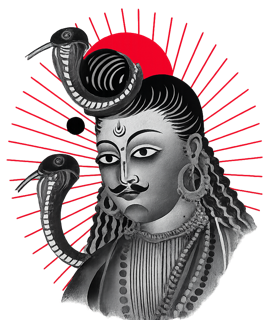
A special introduction to Sādhana School through four timely talks.
Why does identity feel so brittle right now — so urgently asserted and so easily wounded? What is creativity worth, now that a machine can produce a passable poem in four seconds? How does anyone actually begin with a tradition that assumes a teacher, a language, and a lineage most of us don't have? And why does a culture with unprecedented lifespans have no account of growing old except decline?
These are contemporary questions. The non-dual Śaiva-Śākta Tantrik traditions are emphatically not contemporary — and that is precisely why they are worth consulting. They developed accounts of selfhood, creativity, initiation, and ageing that don't sit anywhere on the current menu of options, because they were built before the assumptions that produced our impasses were in place.


Where Do I Begin?
A Primer for Tantric Study & Practice
Tantra is one of the most misrepresented bodies of thought in the modern world — and one of the most genuinely difficult to enter. The texts assume a teacher. The vocabulary assumes a tradition. And the popular material bears almost no relation to the actual literature.
This is the practical evening: a map. What the tradition actually is and where it came from, which texts to begin with and in what order, how study and practice are meant to work on each other, and what the common wrong turns look like. If you have been circling this material for years without knowing where the door is, this lecture is the door.
LECTURE 1 | SEPTEMBER 22
The Cosmic Artist
The Radical Truth of Infinite Creativity
For Abhinavagupta, reality is not a machine, an accident, or a moral examination. It is an act of art — a self-expression so complete that it forgets itself in order to be surprised. Consciousness creates the world the way a poet creates a line: freely, for no reason outside the creating.
If this is true, creativity is not a talent some people have. It is the structure of being itself, and your own smallest act of making participates in it. This lecture takes up svātantrya (absolute freedom) and camatkāra (the astonishment of aesthetic recognition), and asks what it does to a life to take the artist-cosmos seriously.
LECTURE 2 | SEPTEMBER 24
The Identity Trap
A Tantrik Inquiry into Personal Identity and Absolute Self
We live in a moment saturated with identity — asserted, defended, policed, performed. And yet the more precisely we specify who we are, the more brittle the self seems to become. The Tantrik traditions have a striking diagnosis: the trap is not that our identities are false, but that they are contracted — real, but far smaller than what they are made of.
This lecture explores the difference between the identity we construct and defend, and the absolute "I" (pūrṇāhantā) that the tradition insists is already the case. Not the dissolution of the person, but its restoration to its full scale. What might it mean to hold an identity without being held by it?
LECTURE 3 | SEPTEMBER 29
Am I Going Crazy?
A Tantrik Theory of Spiritual Experiences
Involuntary trembling on the cushion. Waves of unbidden bliss. The floor of the self falling away mid-sitting. A dream that arrives with more authority than waking life. Many practitioners meet these experiences without any vocabulary for them, and the two explanations on offer both fail: pathologize it, or inflate it.
The non-dual Śaiva tantras propose a third possibility. Abhinavagupta and his lineage catalogued the phenomenology of awakening with striking precision — the five signs of śaktipāta, the gradations of āveśa or immersion, the distinction between a genuine descent of grace and the ordinary churn of a restless mind. Far from anomalies to be managed, such experiences were read as diagnostics: evidence of the intensity of grace and of where a practitioner actually stands on the path.
LECTURE 4 | OCTOBER 1
Enjoy All Four
Each session runs 90 minutes: roughly an hour of teaching, followed by open conversation. Come to one, come to all four. Recordings are shared afterward with all who register.
These lectures are also a natural doorway into Sādhana School, which is now open for enrollment for our 2026-2027 cohort. Where the lectures raise the questions, the School is where we explore many questions more deeply — in three eight-week sādhanas and an annual retreat, anchored to seminal Sanskrit texts and a commitment to daily practice. If you find something in these lectures, Sādhana School is our program for serious students.
Jacob Kyle
Jacob Kyle is a meditation teacher, writer, philosophy educator, and the Founding Director of Embodied Philosophy. His guiding mission is to re-imagine the modern function of the yoga teacher in alignment with the teachings, texts, and traditions of yoga's profound history. He believes that by building a network of teachers who share a commitment to disseminating the deeper teachings and practices of yoga, we can build a world based on wisdom rather than ideology and divisiveness.
Jacob is a doctoral student at the University of Oxford, researching Abhinavagupta's Philosophy of Language and Meditation with advisor Diwakar Acharya. He holds an MPhil in Classical Indian Religions from Oxford (2023), an MA in Philosophy from the New School for Social Research (2017), and an MSc in Political Theory from the London School of Economics (2007). Jacob is a passionate advocate of Kashmir Śaivism and a devoted practitioner of the Śaiva-Śākta Darśana.
LIVING ROOM LECTURE HOST & TEACHER
ABOUT EMBODIED PHILOSOPHY
Why trust what we offer...
PRACTICE. PROCESS. PROGRESS.
Embodied Philosophy is education for the whole human – mind, body and spirit. Many yoga platforms neglect the spiritual and mental training that is central to yoga's philosophy and history, making much modern yoga little more than exercise. Our programming explores the intersection of ancient wisdom and modern perspectives. We believe that a combination of contemplative practice, deep study and a collective cultivation of peace will build a better world.
FILL OUT THE FORM
We'll Send You Your
Link to Join Live
©2026 Embodied Philosophy. All rights reserved. Privacy Policy


