The Inner Saboteur
Reframe how you understand shadow work . . .


NOW ON DEMAND
A Tantric Approach to Shadow Work

Beyond Integration.
A Tantric Reframing of the Shadow.
The “inner critic” is a familiar figure — the part that withholds, defers, betrays the work just as it nears completion. The inherited frame for working with such figures is Depth Psychology as inspired by the work of Carl Jung. In this framing, shadow as disowned material to be recovered, heard, and metabolized back into a more whole self. It's a powerful frame, and it has done real work for contemplative communities.
But it carries an ontology that the Recognition tradition does not share: the picture of a fragmented self whose pieces have been scattered and must be reassembled.
In this 2.5-hour workshop, we will reimagine shadow work through the lens of Pratyabhijñā — the philosophy of recognition developed by Utpaladeva and Abhinavagupta in 10th–11th century Kashmir. Pratyabhijñā begins from a different premise. There is no fragmentation to repair, because that expression of consciousness showing up as the saboteur is the same consciousness doing the looking. The saboteur is not a part of you. It is one of the shapes the whole of you is currently performing — your own śakti actualizing the operation of self-limitation.
That reframe subtly changes how we understand shadow work. And it opens onto a practice the tradition actually offers — rather than a borrowed therapeutic technique with Sanskrit terms scattered on top.
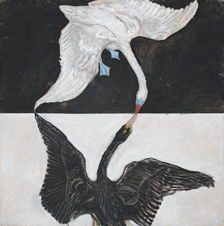
Hilma af Klint, Group IX/SUW, The Swan, No. 9

Participants will learn:
Odilon Redon, The Crying Spider
Recognize what was never fragmented.
A practice of recognition, not integration
This is not a workshop on managing the saboteur, nor is it a substitute for therapy. The Pratyabhijñā tradition holds that there is no part of you that is not already, in some mode, knowing itself — and that the work is not to bring awareness to the contracted figure but to recognize the awareness of it as always already itself.
But how does this actually help us improve those symptoms that arrive as the “inner saboteur”? What you'll leave with is a five-to-seven minute practice you can do when a saboteur-episode arises in daily life. Not as a technique for managing the saboteur. As a practice of recognizing what the saboteur already is, and what it has to say below the bullshit.
Hilma af Klint, Group IX/SUW, The Swan, No. 9
Workshop Agenda
Opening Frame: What Kind of Shadow Work Is This?
The Pratyabhijñā tradition and what it offers — and does not offer — to the contemporary work that encounters a fragmented self.
Lecture 1 (45 min): The Ontology of Recognition
Utpaladeva and Abhinavagupta on cit, vimarśa, and śakti — and why the saboteur is already a form of self-aware consciousness.
Lecture Two (45 min): Saṅkoca and the Shapes of Contraction
How the same awareness that recognizes itself also performs the operation of self-limitation — and what this means for working with the figures that arise from that operation.
Practice (30 min): A Three-Movement Sequence from the Trika Lineage
Sthāna-vicāra (localization), bhairavī-mudrā (outward gaze, inward attention), and anusandhāna (the recognition itself) — taught in three movements with debrief between each.
Closing (30 min): Recognition in Daily Life – A Q&A and Conversation
How to carry the practice into the moments when the saboteur-figure arises — not as a technique for managing the saboteur, but as a practice of recognizing what the saboteur already is.
Jacob Kyle
Jacob Kyle is a meditation teacher, writer, philosophy educator, and the Founding Director of Embodied Philosophy. His guiding mission is to re-imagine the modern function of the yoga teacher in alignment with the teachings, texts, and traditions of yoga's profound history.
Jacob is a doctoral candidate at the University of Oxford, where his dissertation, Manifesting Authority: Prasiddhi, Pramāṇa, and Aesthetic Reason in Utpaladeva and Abhinavagupta, develops an account of epistemic authority within the Pratyabhijñā tradition. He holds an MPhil in Classical Indian Religions from Oxford (2023), an MA in Philosophy from the New School for Social Research (2017), and an MSc in Political Theory from the London School of Economics (2007).
Jacob received dīkṣā into a Tantric form of meditation in 2015, and has since that time been studying and practicing with Kashmir Shaivism scholar-practitioner Paul Muller-Ortega. In 2020, he was initiated as an Acharya (authorized teacher) of Neelakantha meditation. He is a passionate advocate of Kashmir Śaivism and a devoted practitioner of the Śaiva-Śākta Darśana.
100% Satisfaction Guarantee
We know that you'll find this workshop informative, educational and inspiring.
But we want you to know that even if you don't, your purchase is 100% secure.
We will honor all requests for a refund, which can be made by contacting our support team at hello@embodiedphilosophy.com. We promise to have your refund sorted out within 72 hours.
Access this 2.5-hour immersion with Jacob Kyle
The Inner Saboteur: A Tantric Approach to Shadow Work
$79
/ One-time
$249 Value
Inner Saboteur IMMERSION
Awaken to the radical vision of Pratyabhijñā and discover how recognition, contemplative practice, and the wisdom of śakti can transform the way you relate to shadow, selfhood, and the movements of consciousness within you.